
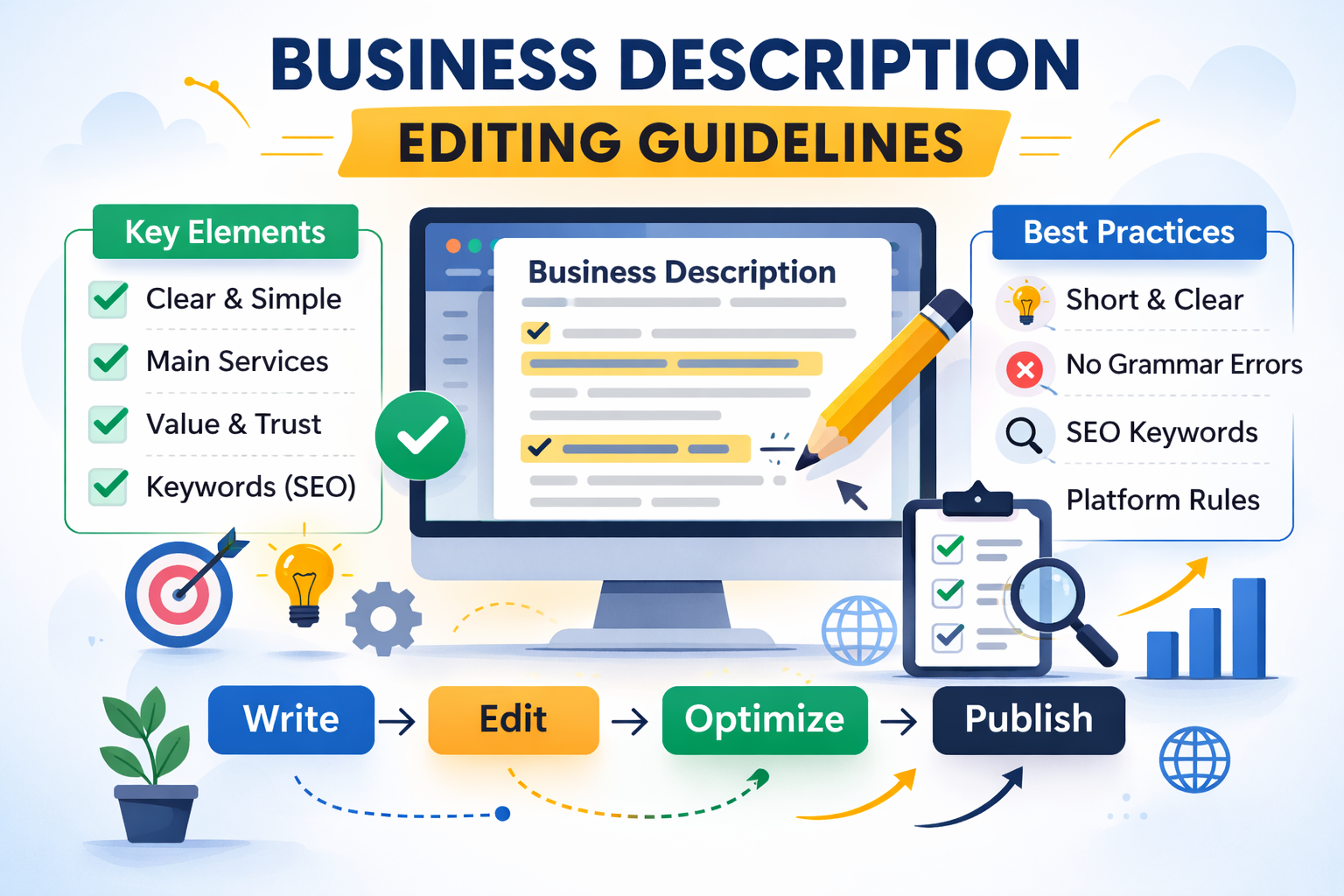
A business description is one of the most important parts of any company profile, website, or business plan. It tells people what your business does, what products or services you offer, and why your business is different from others. A clear and well-written business description can attract customers, investors, and partners. However, writing a good description is not enough—you also need to edit it properly. Editing helps improve clarity, remove mistakes, and make your message stronger.
In this article, we will explain simple and effective guidelines for editing a business description.
1. Understand the Purpose
Before editing, you must understand the purpose of the business description. Ask yourself:
-
Who will read this description?
-
What message do you want to share?
-
What action do you want readers to take?
A business description can be used for different purposes such as marketing, attracting investors, or informing customers. Editing should focus on making the content suitable for its purpose.
For example, if your audience is customers, your tone should be friendly and simple. If your audience is investors, your description should be more professional and detailed.
2. Keep the Language Simple
One of the most important editing rules is to use simple and clear language. Avoid difficult words, long sentences, and complex terms.
Instead of writing:
“Our organization specializes in delivering innovative solutions.”
Write:
“We provide new and useful solutions.”
Simple English makes your business description easy to understand for everyone. It also helps people quickly know what your business does.
3. Check Grammar and Spelling
Grammar and spelling mistakes can make your business look unprofessional. Always review your description carefully.
Here are some tips:
-
Use correct sentence structure.
-
Check punctuation like commas and full stops.
-
Make sure words are spelled correctly.
-
Use tools like spell check if needed.
Even small mistakes can reduce trust, so take time to correct them.
4. Be Clear and Direct
Your business description should clearly explain what your business does. Avoid confusing or unclear statements.
Example of unclear sentence:
“We aim to provide services that meet various needs.”
Improved version:
“We provide cleaning services for homes and offices.”
Being direct helps readers understand your business quickly. Do not use unnecessary words.
5. Focus on Key Information
When editing, remove extra or irrelevant information. A good business description should include:
-
Business name
-
What products or services you offer
-
Target customers
-
Unique selling point (what makes you special)
-
Location (if needed)
Avoid adding too much detail that does not help the reader.
6. Maintain a Consistent Tone
Your tone should stay the same throughout the description. Do not switch between formal and informal styles.
For example:
-
If you start with a professional tone, keep it professional.
-
If your brand is friendly and casual, keep the tone simple and warm.
Consistency makes your business look more organized and trustworthy.
7. Use Active Voice
Active voice makes sentences clearer and more powerful.
Passive voice:
“Products are delivered by our team.”
Active voice:
“Our team delivers products.”
Active voice is easier to read and understand. It also sounds more confident.
8. Highlight Your Unique Value
Your business description should explain what makes your business different from others. This is called your unique value or selling point.
While editing, make sure this part is clear.
Ask yourself:
-
Why should people choose your business?
-
What makes your products or services better?
For example:
“We offer fast delivery within 24 hours.”
or
“We use eco-friendly materials in all our products.”
This helps your business stand out.
9. Avoid Repetition
Repeating the same words or ideas can make your description boring. During editing, remove repeated information.
Example of repetition:
“We provide quality services. Our services are high quality.”
Improved version:
“We provide high-quality services.”
Keep your content short and meaningful.
10. Use Short Paragraphs
Long paragraphs can be difficult to read. Break your text into smaller paragraphs. Each paragraph should focus on one idea. This makes your business description easy to scan and understand.
11. Add Keywords (if for online use)
If your business description is for a website, include important keywords. Keywords help people find your business online.
For example:
-
“bakery in Lahore”
-
“online clothing store”
-
“digital marketing services”
However, do not overuse keywords. Keep the text natural and readable.
12. Check for Accuracy
Make sure all information in your description is correct. This includes:
-
Business name
-
Contact details
-
Services offered
-
Location
Wrong information can confuse customers and harm your reputation.
13. Make It Engaging
A good business description should not only inform but also attract readers.
Use positive and engaging words like:
-
“trusted”
-
“affordable”
-
“high quality”
-
“fast service”
But avoid exaggeration. Be honest and realistic.
14. Read Aloud
After editing, read your business description out loud. This helps you:
-
Find awkward sentences
-
Check the flow of ideas
-
Improve readability
If something sounds strange, rewrite it.
15. Get Feedback
It is always helpful to get feedback from others. Ask a friend, colleague, or team member to review your description.
They may notice mistakes or suggest improvements that you missed.
16. Keep It Updated
Businesses change over time. You may add new products, services, or locations. Make sure your business description is always updated. Editing is not a one-time task. Review your description regularly to keep it fresh and accurate.
Conclusion
Editing a business description is an important step in presenting your business clearly and professionally. A well-edited description helps people understand your business, trust your brand, and choose your services.
To summarize, always focus on:
-
Clear and simple language
-
Correct grammar and spelling
-
Relevant and accurate information
-
Strong and direct messaging
-
Consistent tone and style
By following these guidelines, you can create a powerful business description that leaves a positive impression on your audience.